Mark Making, Printing and Collage – Part 4

On the last day, I made some more paper collages and then moved on to working with fabric.  Caroline Bartlett was very helpful in experimenting and suggesting a way of using the screens to print images that were looser and more akin to drawing. This was more appealing to me and I returned to my group of chosen objects:

Group 3.jpg

Working on a screen I used three different tools to draw these and came out with an image which I felt better suited my style of working:

My first screen print of found vessels

I felt that this had possibilities although this version is a little too busy.   I prefer the reverse – as is often the case!

So I will now write up my notes, process my photographs and take a little time to digest all that I have learned, but, in the meantime, a big thank you to Caroline and the rest of the group – many lessons learned by all!
Mark Making, Printing and Collage – Part III

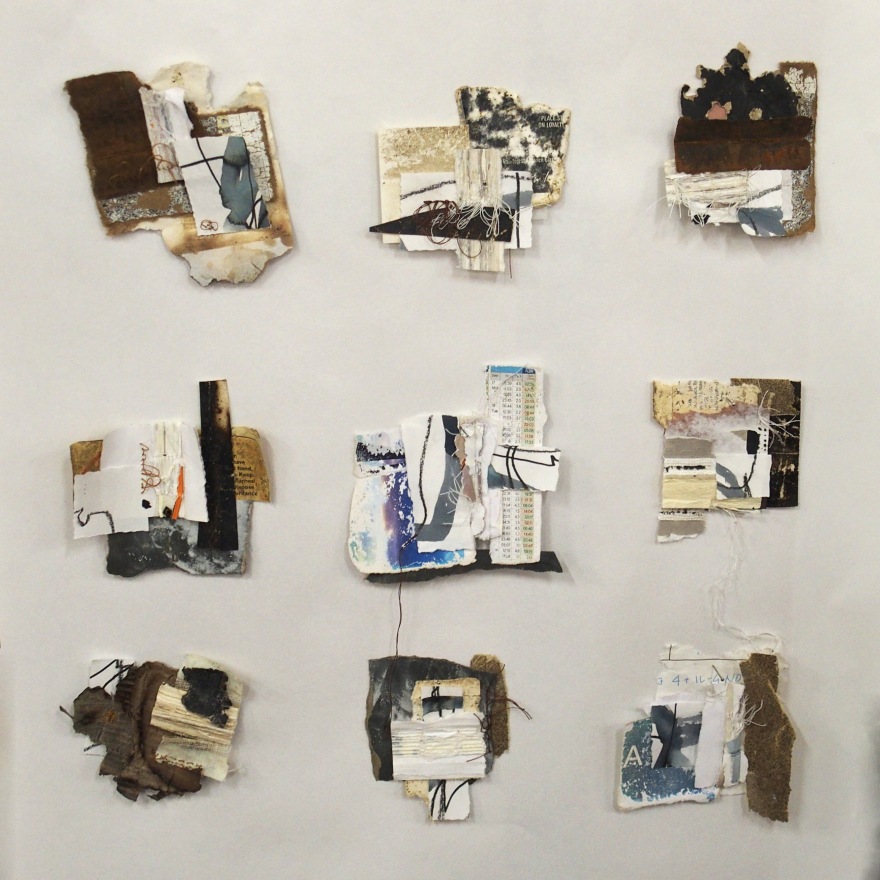
I had brought some papers with me and decided next that I would create a series of collages using, for the most part, genuinely “found” papers.  So often the term “found” is used to describe items which are actually “bought” from second hand shops, car boot sales, online auctions etc.  I try to work, as exclusively as possible, with items that I have found along the Chichester Harbour coastline, adding to them when necessary but always using them as the starting point for my work.  The papers used in the pieces below are:

disposable plate; take away coffee cup; take away sandwich wrapper; take away cookie bag; sandpaper; cider cardboard packaging; miscellaneous plastic; paper from an oil filter; and, most importantly, a tide table.

Disposable food service products made from paper, paperboard, and corrugated fibreboard, including cups, plates, bowls, napkins, take away bags, trays, egg cartons, doilies and tray liners, can also include or be coated with plastic to improve wet strength or grease resistance.

So, my collage collection includes hidden plastic and the title “Turning the Tide” refers not only to the use of a local tide table in the work, but also to the fact that I hope that we are now turning the tide in the fight against plastics and other rubbish in our seas.  This is and will remain the core inspiration behind the work that I produce.

Collins Dictionary – “Turn the tide” – to change the general course of events.

OLYMPUS DIGITAL CAMERA

Mark Making, Printing and Collage – Part II

Caroline had given us a couple of demonstrations showing mono printing and screen printing so my next test was to produce a screen printing.  This is something that I felt was a challenge as I consider my work to be “grunge art!”.  It is far apart from the neat and perfect finish that you think of when considering a screen print.  But I had a go …. I selected one of my found objects and made a stencil.  Next I considered how I might use the screen print and selected a gum arabic transfer of one of my photographs (Itchenor, Chichester Harbour – the source of the object) and a page of text I had written about drinks cans.  My idea was to make the screen print transparent so that the image and the text could be viewed through it.

I thought these effects were promising so went on to produce a series of screen prints:

OLYMPUS DIGITAL CAMERA
Screen prints over gum arabic prints
Whilst I liked these, they were not really “me.”  I parked these and moved on but, for the sake of continuity, this next image shows the next stage in the life of these prints.  I will continue to work on them at home.  This distressed effect is much more in keeping with my ethos.  
OLYMPUS DIGITAL CAMERA


Mark Making, Printing and Collage – Part One

I am just back from a four day course with Caroline Bartlett – who was a wonderfully giving and patient tutor who spent time with each of the six students all working in different ways and with very different outcomes.  Thank you Caroline! We had been asked to bring in a collection of about six small objects with which to work during the course.  Here are mine:

Group.jpg

All of these metal items have been collected from the shore around Chichester Harbour and are, from left to right, a baked bean can, an aluminium canister, a shell case from world war 1, a Fanta can, an old paint can, and an aerosol butane gas lighter fuel canister.

To warm up, we were asked to produce a series of continuous line drawings using a variety of media. I chose to overlap my drawings of just one object, the paint can, to start with.

The use of thin paper meant that by turning it over and working on both sides, you could see through from one side to the marks on the other.

Next, I made a template based on the paint can and made a series of cut out’s using some paintings I had already made and brought with me.  Here’s one:

Finally, I thought that the row of objects together made for interesting shapes so went back to the continuous line drawing, using the reverse of a piece of paper already drawn onto:

OLYMPUS DIGITAL CAMERA

I’ll return to this later when looking at screen printing.

Little Beauties

Earlier this year, my husband and I had a wonderful two weeks in beautiful Northumbria. It was our first visit and won’t be our last.  Three things summed it up for us – glorious unspoilt beaches, warm and friendly people, and excellent well priced food!  What more could you want?  The weather was fantastic and, apart from the day that Storm Ali came and blew my husband’s prescription glasses into the North Sea, but that’s another story!

Due to the kindness of a couple of folk on my favourite Facebook Page – “Beachcombing, British Coastline), I found my way to a great spot near Seahouses and also to Seaham in County Durham.  Here I found not the plentiful sea glass, pottery or limpets in plentiful supply elsewhere, but my sort of found objects:

When I got home, I had a lovely time putting together mini assemblages from these and other bits and pieces