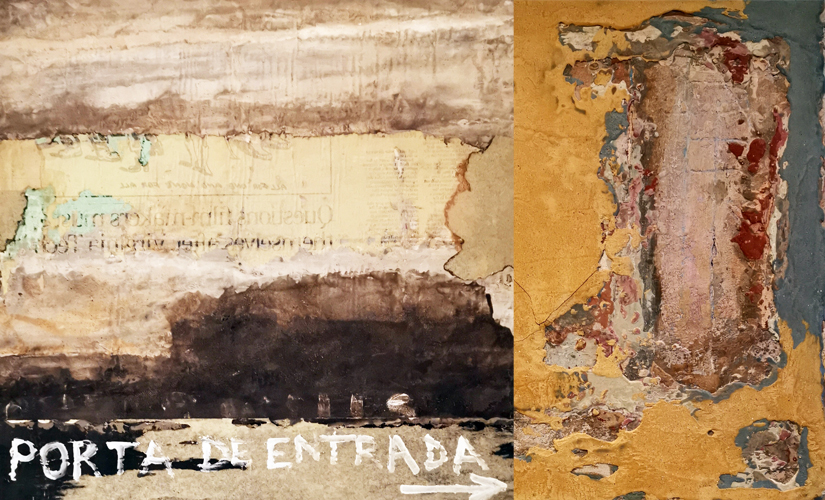
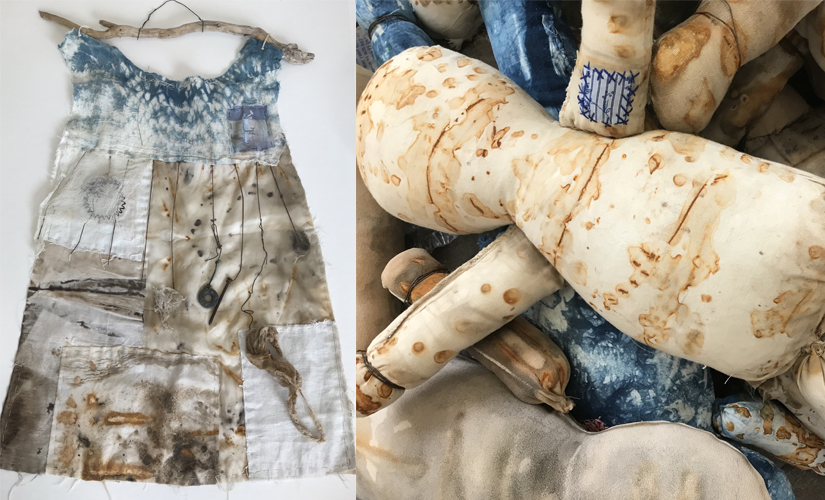
I am very excited to say that I will be taking part in “creative redemption” at The Oxmarket Gallery in Chichester. As their site says,
“This is a moving exhibition by artists all of whom, in their own way, have benefitted from the restorative powers of their personal creative process. In the honesty of revealing the wounded condition, powerfully sensitive works of art have been born; beautiful in their own right, but also serving to offer empathy, encouragement and hope.
With refreshing honesty, Helen Frost, Christine Habib, Nicola Hancock, Helio Teles and Julie Turner have revealed the wounded condition through their individual response, presenting a highly sensitive and powerful collection of works.”
The exhibition runs from – Tuesday – Sunday 10 – 4.30 and there is a “Meet the Artist” session with tea and cakes Saturday 2nd February 2 – 4 p.m. We hope to see you there!
A friend and I decided to visit this last week, lured by the introduction of the Gallery’s website:
“The notion of the found object as artistic material, content and subject-matter provides the inspiration for The Everyday and Extraordinary, an exhibition presenting a Wunderkammer of modern and contemporary artworks drawn from the Arts Council Collection. The show brings together a fusion of materials, processes and innovative ideas, celebrating the physicality of objects in this predominantly digital age.
Found objects or ‘objet trouvé’ provide infinite inspiration for artists. When, in 1913, Marcel Duchamp used a found object in his work, he introduced the term ‘ready-made’ to art. Whether modified, presented in a new context or left unchanged found objects have had an enduring impact on artistic practice, with artists appropriating and transforming objects in many ways to communicate particular ideas or concepts. Surrealists used ‘the everyday’ as an invocation of humour and satire whilst Pop Artists directly appropriated items from popular culture. Techniques of the ready-made continue to engage and inspire contemporary artists today.”
We both like to use found objects in our work so thought this exhibition would be right up our street.
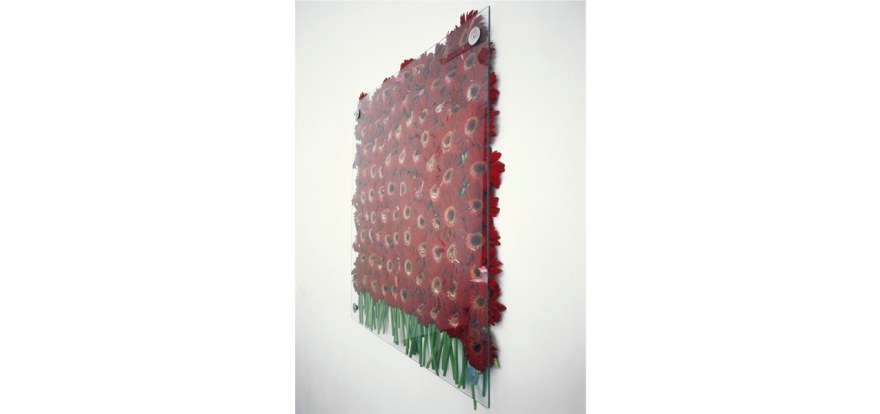
Anya Gallacio’s installation Preserve (Chateau) shown above in its original form, has been deliberately allowed to rot and is now looking very sad. The frame is somewhat misted up and the flowers have died and are dropping out of the base. Stated to be a sombre meditation on the passing of time, it consists of 100 red gerberas sandwiched between the wall and a pane of glass. Preserve Beauty was the paradoxical title of a work in which no attempt is made to conserve the wilting flowers.
I liked Mona Haltom’s sculpture + And – but, like many other exhibits, it does not incorporate found objects. A wooden box is filled with sand. Like a clock, it’s two hands rotate. The serrated hand draws concentric rings in the sand and these are then obliterated when the smooth hand follows. There is something soothing about this repetition.
The above work by Tony Cragg was made in 1978. This does use the found – hundreds of pieces of plastic. As a regular beachcomber, I identified with the fact that there is a horrendous amount of such items to be easily found upon our shores and I can only suppose that forty years ago this work was saying something new. Today I found it too simplistic to be considered a piece of art.
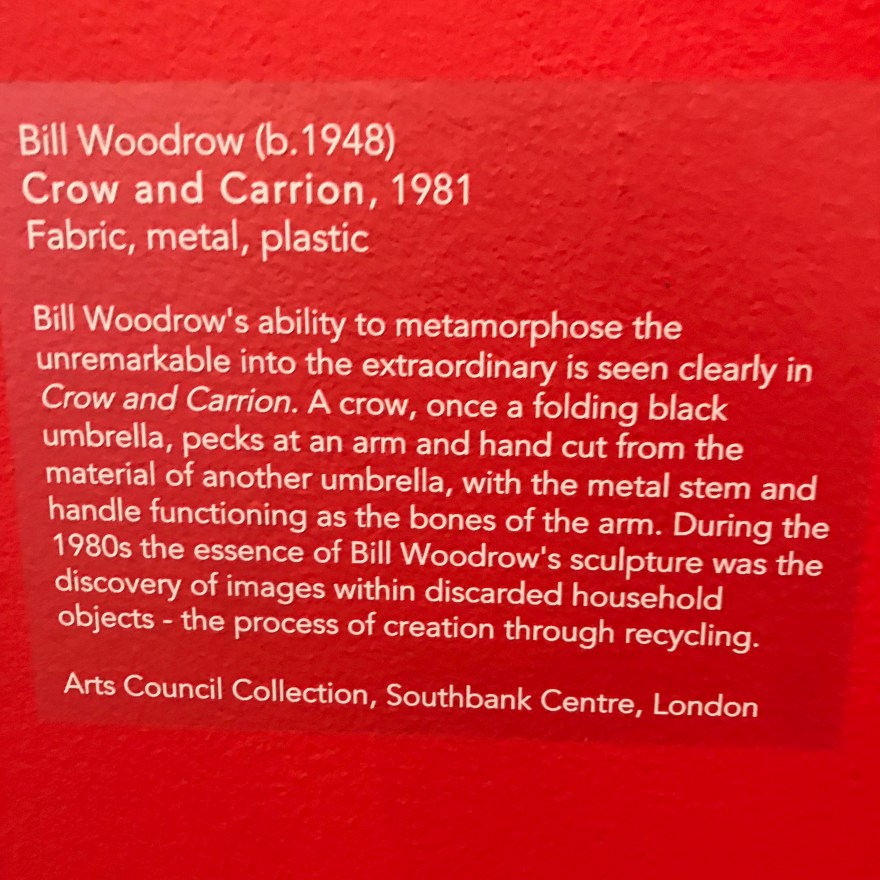
I did like the following exhibits which I photographed together with their notes:
but, overall, my friend and I both considered the exhibition disappointing. Too few exhibits featuring the genuinely found and those that did, were not particularly inspiring. Do let me know what you think!
And finally, we walked along the seafront where we saw two of the five new beach huts installed recently and available to hire. As art installations, I enjoyed them. You can read more about them and view the others by following the link above:
Caroline had given us a couple of demonstrations showing mono printing and screen printing so my next test was to produce a screen printing. This is something that I felt was a challenge as I consider my work to be “grunge art!”. It is far apart from the neat and perfect finish that you think of when considering a screen print. But I had a go …. I selected one of my found objects and made a stencil. Next I considered how I might use the screen print and selected a gum arabic transfer of one of my photographs (Itchenor, Chichester Harbour – the source of the object) and a page of text I had written about drinks cans. My idea was to make the screen print transparent so that the image and the text could be viewed through it.
Distressed Fanta Can
Stencil cut out over gum arabic print of Itchenor
Stencil cut out over my text
I thought these effects were promising so went on to produce a series of screen prints:
Screen prints over gum arabic prints
Whilst I liked these, they were not really “me.” I parked these and moved on but, for the sake of continuity, this next image shows the next stage in the life of these prints. I will continue to work on them at home. This distressed effect is much more in keeping with my ethos.
I am just back from a four day course with Caroline Bartlett – who was a wonderfully giving and patient tutor who spent time with each of the six students all working in different ways and with very different outcomes. Thank you Caroline! We had been asked to bring in a collection of about six small objects with which to work during the course. Here are mine:
All of these metal items have been collected from the shore around Chichester Harbour and are, from left to right, a baked bean can, an aluminium canister, a shell case from world war 1, a Fanta can, an old paint can, and an aerosol butane gas lighter fuel canister.
To warm up, we were asked to produce a series of continuous line drawings using a variety of media. I chose to overlap my drawings of just one object, the paint can, to start with.
Paint can 1
Paint can
Paint can 3
Paint can – Continuous line drawing
Continuous line drawing 3
Continuous line drawing 1
The use of thin paper meant that by turning it over and working on both sides, you could see through from one side to the marks on the other.
Next, I made a template based on the paint can and made a series of cut out’s using some paintings I had already made and brought with me. Here’s one:
Paint can found Fishbourne
Acrylic ink and rust close up
Acrylic ink and rust
Finally, I thought that the row of objects together made for interesting shapes so went back to the continuous line drawing, using the reverse of a piece of paper already drawn onto:
I’ll return to this later when looking at screen printing.
Earlier this year, my husband and I had a wonderful two weeks in beautiful Northumbria. It was our first visit and won’t be our last. Three things summed it up for us – glorious unspoilt beaches, warm and friendly people, and excellent well priced food! What more could you want? The weather was fantastic and, apart from the day that Storm Ali came and blew my husband’s prescription glasses into the North Sea, but that’s another story!
Due to the kindness of a couple of folk on my favourite Facebook Page – “Beachcombing, British Coastline), I found my way to a great spot near Seahouses and also to Seaham in County Durham. Here I found not the plentiful sea glass, pottery or limpets in plentiful supply elsewhere, but my sort of found objects:
Conveyor belt parts
Rubber on textile
Old boat nails
Miscellaneous metal
Light bulb parts
Old flex
When I got home, I had a lovely time putting together mini assemblages from these and other bits and pieces






 Helen Frost Artist