The word “abstract” is generally thought of having several meanings. The most well known might be:
- “relating to or denoting art that does not attempt to represent external reality, but rather seeks to achieve its effect using shapes, colours, and textures.” but, used as a verb rather than an adjective, another is:
- “to extract or remove (something).
Both uses of the word cropped up for me yesterday at a day’s workshop with the excellent Ronnie Ireland. A couple of weeks ago Ronnie visited Chichester Art Society and gave a talk “Catching The Image” – Where do ideas come from – how can we develop them?” It was a very interesting evening – Ronnie was obviously hugely knowledgeable about the history of art and passionate about his subject. The workshop encouraged us to consider working in a new way by selecting two or three images (maybe photographs or text, our own or from magazines) that meant something to us or spoke to us in some way.
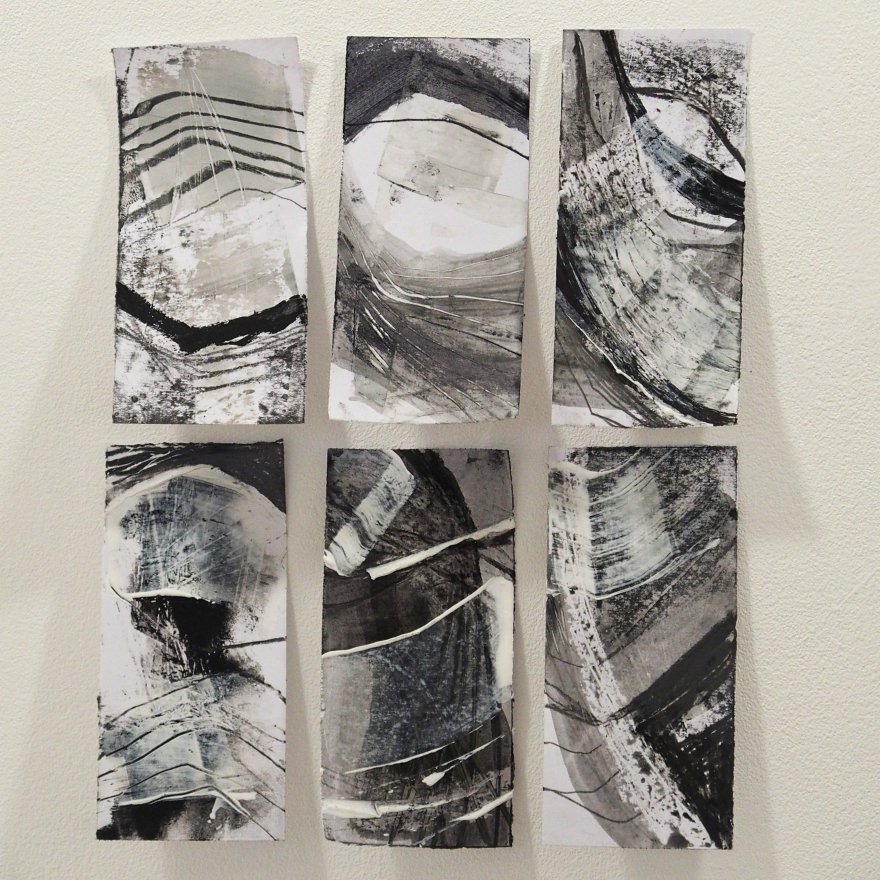
The first task was to draw a series of thumbnail sketches to compare and contrast different ideas for composition. As I always seem to find my work ends up as landscape or seascape I decided to make a concerted effort to be “abstract”. I had chosen three images to work with: seaweed swirling in a circular motion in the sea; a black and white image of an abacus and a black and white photocopy of some textile work that I had done on a workshop with Cas Holmes. Here are the six thumbnails:
I chose the last image to recreate larger and in colour:

I didn’t like it …. and nor did Ronnie! He then asked if this was how I normally worked. It isn’t – I like to work spontaneously, working with the paint or paper and letting the work evolve as I go. He told me to carry on as I normally did! I had brought a collection of papers with me – leftovers from past workshops and “play days” as I had decided to work with collage during this day (typical me – of course everyone else worked in paint)!
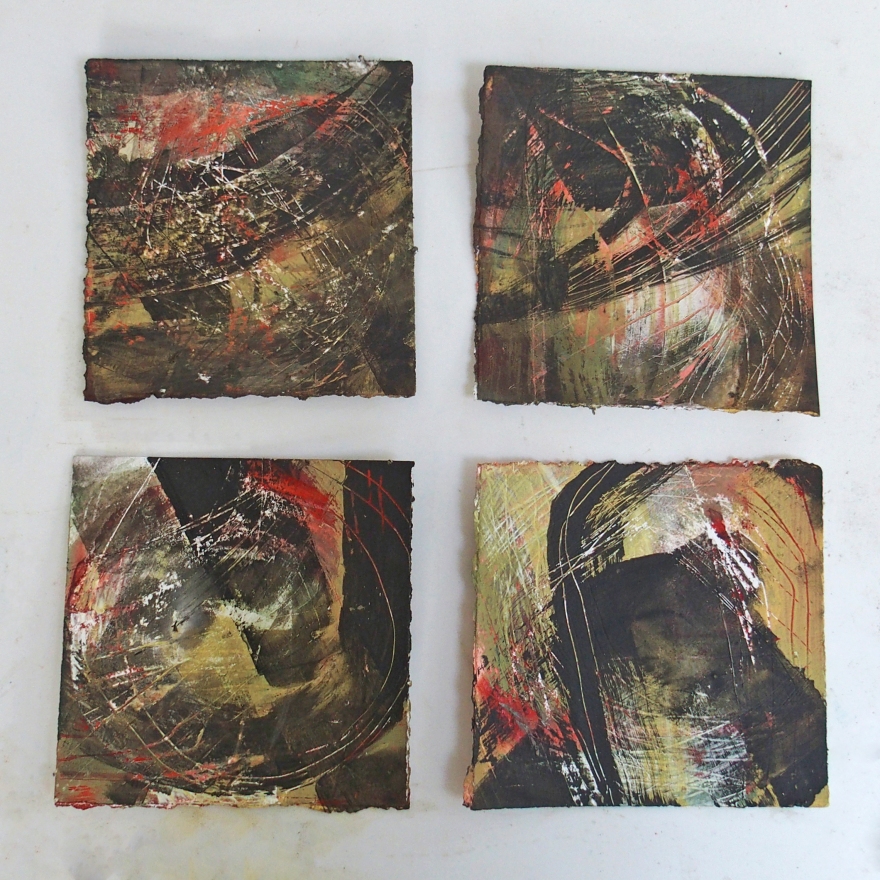
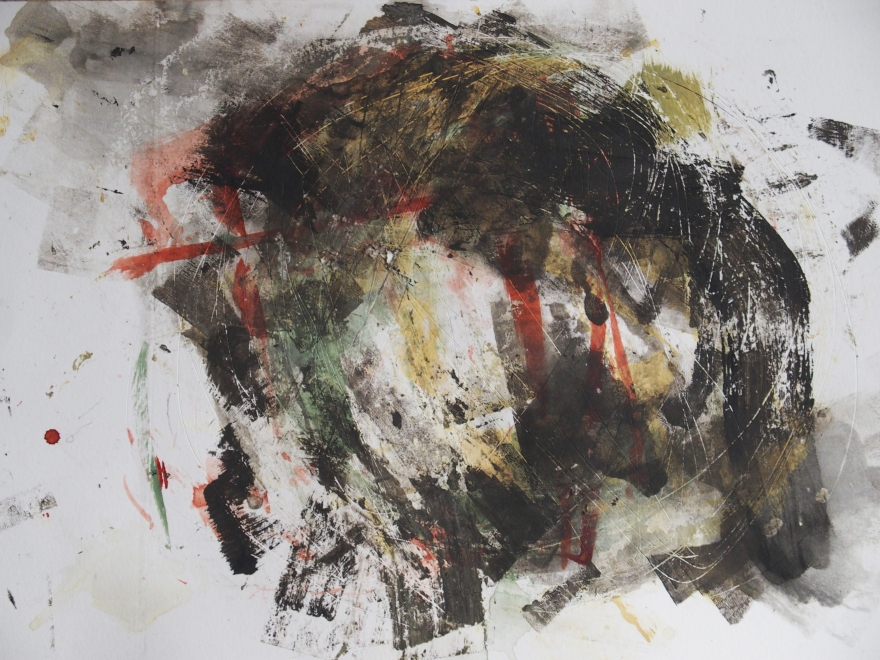
Here are my outcomes:
I was pleased to have managed to keep away from horizons! Ronnie felt that the first had most promise but that the others were too busy. He asked me to take away and take away until I thought I had gone too far and then to put one thing back. This made me simplify the work. I then went back and cropped the images to simplify them still further – the word “abstract” occurred again:
This slideshow requires JavaScript.
so my next step is to consider what I have learned and take the work further. I may work in collage or I may work on paper to create the whole image in paint. Either way what I have here expresses my love of texture and mark making and I shall enjoy creating new surfaces. Next time, instead of using whatever paper I have to hand, I will create surfaces which directly relate to my running theme of found objects and re-create the distressed surfaces of the metal, wood, fibreglass and so on that I collect. Ronnie was keep to impress the importance of making work that matters to you and that you are passionate about. I can also see how this would translate to fabric with the exciting option of adding stitch to create thin lines which would relate back to my initial thumbnail sketches (Cas Holmes will be pleased!). To be continued …
N.B. In case you hadn’t gathered I would highly recommend spending time with Ronnie – he is based in Farnham, Surrey and runs workshops and classes, gives talks and offers one-to-one to tuition. I have a feeling I will be seeing him again!

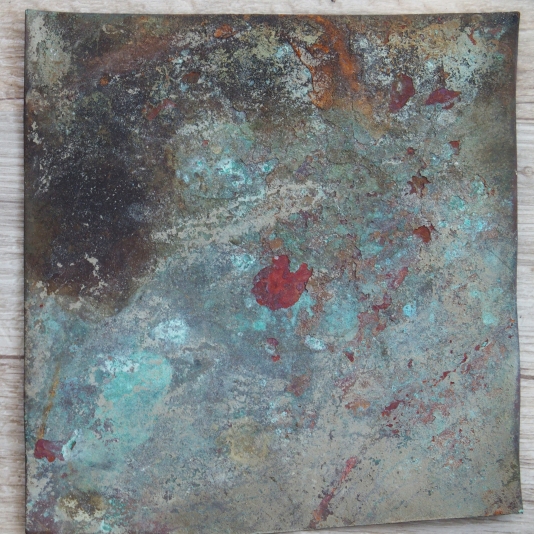


 The Chichester Art Trail has finished! For the first time, Alan and I opened our home for five days over the first two weekends in May. We had a great time! Whilst the volume of sales was not huge, we both did sell work and, what was just as important, received some fantastic comments from people who came round. We had 194 visitors – some came to see Alan’s monochrome photographs including those of Chichester Harbour and church interiors; some came to see my found object and mixed media work and most enjoyed both. Although our work is very different it does complement each other. There is a similar colour palette i.e. simple, earthy tones – I describe his work as precise and perfect whilst mine is distressed, tattered and torn and yet the two seem to work together.


 Helen Frost Artist