
So much has already been written about the situation we find ourselves in due to Coronavirus. It has had a massive impact on the lives of many and my husband and I count ourselves to be very fortunate that the impact on our lives has been very small. I propose to restrict my comments here to focus on how lockdown has affected my days as an artist.
Firstly, my daily routine is now to walk from our house around Chichester Harbour, specifically taking in three different routs from Fishbourne to either Apuldram to the edge of Bosham. I cannot beach comb here, for although there is water, there is no beach. Instead of picking up trash and treasure, I have collected images of the wildlife that I have encountered each day.
Secondly, I have found myself feeling the need to have a clear out in the studio. As you might imagine, I have accumulated a mass array of beach combed items – metal, wood, rubber, plastic, leather, paper – some are kept to be used as a collection, maybe to make an environmental point. Others remain simply because they appeal to me in some way. Quite a lot has now gone (of course, it cannot literally “go” anywhere at present, so it is round the side of the house!) This has been quite liberating.
Thirdly, through necessity, I am working with what I already have. It had become a habit to walk a different beach each day and to collect and I confess to spending more time collecting and less time making. The work that I do all obviously firstly about “the found” but is next about curation. I need to know what I have to work with and decide which piece fits with another. For me this is intuitive – I don’t plan ahead but work with what my hand and eye tell me to do. This does not always work first time and I can spend a day without achieving anything pleasing. Sometimes, however, I just seem to be “in the zone” and things come together.
My working style grew out an appreciation of the found, the worn and the distressed. Now that there is no longer a constant stream of materials entering the studio, I can knuckle down and work with what I have. This is more challenging but I hope it will be just as rewarding. I plan to revisit my drawers of papers and fabrics, accumulated over several years. These are not “found objects” in the truest sense but the work that comes from them will be made using “recycled” materials in the sense that I will re-use discarded or unfinished starting points.
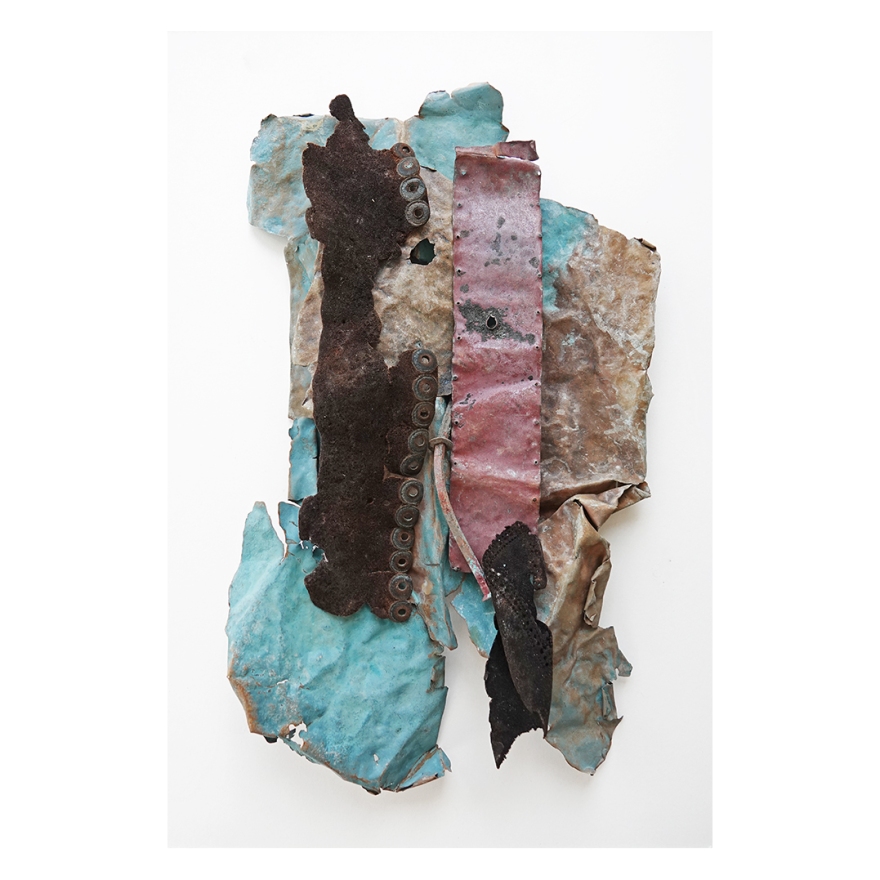
“Muntz waistcoat” is made from found “Muntz” metal, copper and leather, all collected from the Chichester Harbour area.
Muntz metal is an alloy consisting of 60 per cent copper and 40 per cent zinc, named after the English businessman George F. Muntz, who patented it in 1832.
Over the years, I have many pieces, large and small, which are probably fragments of 19th Century ships’ hull sheathing. I am told that there are many wrecks off the coast and, particularly after a storm, metal is left along the shoreline. Although the wooden hulls have disintegrated, the hull sheathing usually remains. I also find large and heavy lumps of wood with copper nails and bolts on a fairly regular basis. Pure copper sheathing is more reddish in colour, and much harder to find, as it was used mostly before 1832, before Muntz metal was patented.
One of the best examples of a Muntz metal sheathed hull, is the restored stern draft and rudder of the famous British Clipper Ship Cutty Sark that was built in 1869 for the Jock Willis Shipping Line.
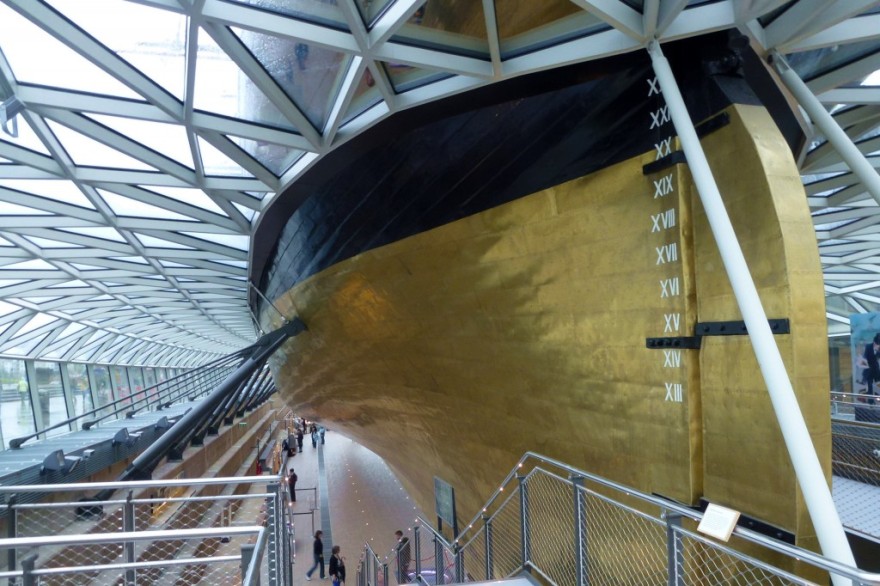
The restored stern (with stern draft and rudder) of the Cutty Sark elevated 3 metres above its dry-dock under its glass-roofed visitors’ centre in June 2012.


 The Chichester Art Trail has finished! For the first time, Alan and I opened our home for five days over the first two weekends in May. We had a great time! Whilst the volume of sales was not huge, we both did sell work and, what was just as important, received some fantastic comments from people who came round. We had 194 visitors – some came to see Alan’s monochrome photographs including those of Chichester Harbour and church interiors; some came to see my found object and mixed media work and most enjoyed both. Although our work is very different it does complement each other. There is a similar colour palette i.e. simple, earthy tones – I describe his work as precise and perfect whilst mine is distressed, tattered and torn and yet the two seem to work together.


 Helen Frost Artist