From Trash to Treasure

Well I think so anyway!  I fully appreciate that these pieces will appeal to a minority audience but I have enjoyed using my found pieces in a way that pleases me.  Here are two of the three final objects in their original state – an anorak cuff and a rolled up piece of rubber, original purpose unknown:

I knew that I could see potential in both of these items – lots of lovely texture – but knew also that they needed more.  I decided to construct a third piece using some found black plastic, made interesting by the sea.  I then played about with different additions until I found what I wanted, and added stitch.

I wanted to make each piece interesting on the outside and the inside and felt that they worked best as a trio.  I plan to sit them on a piece of found wood (yet to be retrieved from my stash in a nearby garage!) and hope to source something like a vintage taxidermist glass dome to go over the top.  Here are the three pieces now:

Black cream and rust trio

These images do not show what is going inside the three vessels – you’ll just have to come along and see them during the Chichester Art Trail to see the full effect – Chichester Art Trail 2018


This is rubbish ….

As you know, I like to collect “rubbish” from the beach.  They say beauty is in the eye of the beholder, and, for me, beauty comprises colour, texture, and composition that appeals to the eye.  Most definitions of art include the need for human intervention.  In the example below, fire and water have done the intervening.

This is the found item on the beach.  It is about 10″ x 7″, weighs 270g and is quite fragile.  I first saw the dark surface and then turned it over:

I was immediately drawn to this item.  I love the complexity of texture that has been formed quite randomly by the bonfire.  I could keep looking at it for ages and keep seeing different areas of interest. There are layers upon layers and whilst it has clearly been burned, there are areas of colour in addition to the expected black and white.  It is very much in tune with my colour palette.

I have recently bought a book by the American collage artist Crystal Neubauer called “The art of Expressive Collage”.  This extract is from the Introduction:  The intuitive artist is the artist who trusts what her eye tells her is good.  She allows for the fact that she has a story to tell through art, but lets go of the notion that the story will be known before she starts working.”  And, in Chapter 1, “Do not stop to question why something has caught your eye.  If it has your attention there is a reason for it.”  This exactly echoes how I feel about my found pieces.  But what next?  First of all, here are the pieces again:

How much better they look without the visual distraction of the stones!  My constant dilemma is to ask myself “Is that enough?” and whilst I consider this found item to be a thing of beauty, going back to the definitions of art such as “The expression or application of human creative skill and imagination, typically in a visual form such as painting or sculpture, producing works to be appreciated primarily for their beauty or emotional power.” (OE) it does not fulfil these parameters because, as yet, there has been no human intervention (or at least none taken with an intention of creating art).

The two sides of the piece are, of course, different and I cannot choose one over the other. The darker side is reminiscent of bark with some lichen growing in places.  The other side includes a bit of seaweed, some metal, a twig, and plastic, foam and melted surfaces can be discerned – it reminds me of lava and also termite nests.

I would like to display this so that both sides can be seen – perhaps mounting it in a perspex box.    The question is – how, if at all, to add my intervention?  Assuming that the piece is displayed in a box, any background pattern would be too distracting unless it was very lightly done.  Perhaps a subtle pale distressed finish would be appropriate but it would have to be done in such a way as to leave the object unobscured from both sides.   Then there is the question of securing it within a box format – I can imagine it suspended but how to get anything through the structure would be a challenge.  Maybe having it on a stand would be a safer option – it cannot stand on its own as it is and I would not want to push one end into a support as it would no longer be seen.

This is puzzle to ponder over a while longer.  I may decide to stick with displaying just one face of the item and that would make the presentation a much easier process.  Any thoughts gratefully received!

I’ll let you know what I decide.  I’ll be seeing our framer next week and he may well have some ideas too.

Going Abstract

There is no doubt that my taste is changing – I am drawn to more abstract and semi abstract work than I was when I was younger.  I wonder why?  I see marks and patterns that attract me in the strangest of places, even in rubbish.  As you know, one of my hobbies is beach combing.  I like to collect objects that are weathered and distressed by the sea – these are nearly always man made items – whilst I appreciate the beauty of stones and shells I do not feel the need to collect them.

It is unusual to find paper on the beach as it is easily broken up by the waves – not so, sadly, the plastic.  These are some bits collected recently:


A crisp bag, a sandwich wrapper and other plastic.  I like the way the colours and text have been eroded and altered by the action of the sea.

But, the big question of course, is how can these be used in “Art”.  Well, as a start, I played around with composition, decided I needed a bit more texture and added some found duct tape.  So the next stage could be to reinterpret these shapes and colours in mixed media …. a project for the New Year.

Abstract from rubbish

Fire and Rust or “The remains of the day”

Dell Quay 3 - 26/08/16
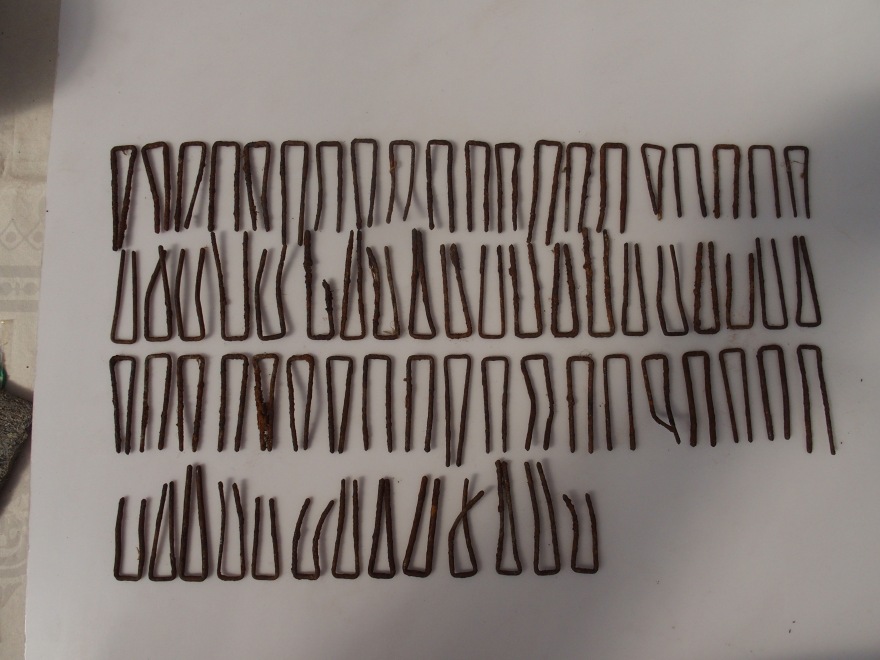
Rusty Staples from the bonfire


I have long been fascinated by decay, distress and general wear and tear in surfaces.  My eyes are drawn over and over again to rock, stone, wood, paper or any material where the worn and battered winks at me and asks for further inspection.  I love torn edges and scruffiness.

Taking up more and more room in the house, I have an embarrassingly large collection of found objects that reflect my preferences and I am still struggling to find a clear way forward to use these within my art.  I am unable to pigeon hole myself as a “painter”, “printmaker”, “textile artist” or some other moniker – I like all manner of techniques and media. The saving grace is that there is a common need –  to make use of the found and to conform to my idea of what is aesthetically pleasing as outlined above.  I realise that to some/many my taste is bizarre and that anything I produce will have a limited market with the majority doubtless seeing only “rubbish.” I also need to distinguish myself from what I see as twee – sculptures and assemblages made from pieces of driftwood for example.  They are just not me – not dirty enough, not raw enough, not scuffed and damaged.

Some of what I produce will be fragile (I have some beautiful charred paper from an incinerator); some will have a shorter life than “traditional” art because it will continue to erode and spoil over time.  But I will persevere with my ideas that involve the found, the rusty and the burnt.  I have workshops coming up in 2018 with the inspiring Debbie Lyddon whose textile work I simply love and also with Elaine Bolt who I hope will take me down a new route considering ceramics and they can help me display my found objects.  I was delighted to discover her although a little sad to see that my ideas are not entirely new – ideas rarely are! – and that she is producing far lovelier work than I am sure I will manage.

I am currently thinking about my collection of found brushes (some are shown above) – I have already started to experiment with embossing and “printing” with the handles and would like to try making ceramic handles in the form of these found brushes.  I have a collection of “bristles” that can be fastened to the handles and yesterday rescued a whole pile of lovely rusty, “been through the bonfire” bendy metal from which I can form ferrules to adjoin the handles to the bristles.

Here are a collection of my other “from the fire” objects which I hope to use in future work.  I’d love to know if anyone else “get’s it”!!